 ZINQ_Gerd_Kaemper
Planet ZINQ Live: Hendrik Wüst Visits ZINQ at Klimahafen Gelsenkirchen
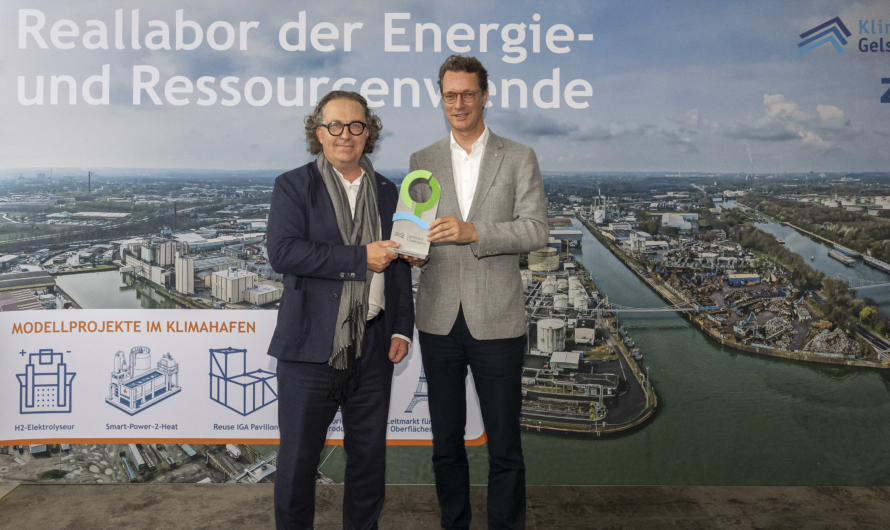
What does climate neutrality look like when it’s not just announced but implemented step by step? North Rhine-Westphalia Minister President Hendrik Wüst got a firsthand look at this during his visit to ZINQ at the Klimahafen Gelsenkirchen. Together with Gelsenkirchen Mayor Andrea Henze, he learned on site how ZINQ is tackling the transformation in practice.
The Klimahafen Gelsenkirchen is a consortium of more than 15 companies at the city harbor, including ZINQ. Together, the companies are working on solutions for industrial transformation. The focus is on the energy and resource transition. The initiative is supported by the City of Gelsenkirchen, the Chamber of Industry and Commerce (IHK), and the scientific community. Two key projects come from ZINQ itself: H2Raum for hydrogen utilization and the Digital Circular Product Passport. Both are part of Planet ZINQ, the climate protection company’s circular business model. It represents the path to true climate neutrality, with products of “triple-zero” quality—that is, zero emissions, zero waste, and zero pollution.
During the tour of the production facilities, the Minister President gained insights into the energy-intensive processes at ZINQ’s Gelsenkirchen site. Here, ZINQ keeps more than 600 metric tons of zinc molten around the clock at approximately 450 °C. The family-owned company is working to gradually generate the heat required for this using lower-carbon energy sources instead of natural gas. At the Klimahafen, industrial process heat is a key area of focus: electricity from renewable energy sources and natural gas are to be flexibly combined here, with hydrogen also being considered for the future. As part of the H2Raum project, ZINQ is collaborating with the Westphalian University of Applied Sciences and ProPuls to test the use of hydrogen in surface treatment technology.
The second area of focus is the resource transition: The goal here is to make circular quality measurable and comparable. One example of this is the Digital Circular Product Passport for metallic surfaces and steel products, which ZINQ developed as part of the Prosperkolleg initiative and is now applying to specific value chains in collaboration with partners.
“We need solutions that combine climate neutrality and competitiveness, especially for energy-intensive small and medium-sized enterprises,” said Lars Baumgürtel, managing partner of the ZINQ Group and president of the North Westphalia Chamber of Industry and Commerce. At Klimahafen, such solutions are developed and tested under real-world industrial conditions.
During his visit, North Rhine-Westphalia Minister President Hendrik Wüst emphasized: “North Rhine-Westphalia is an industrial state—and it should remain so in the future. Climate protection and a strong industrial sector are not mutually exclusive. What matters is that we succeed in putting innovations into practical use and providing our companies with the conditions they need to produce in a climate-neutral yet competitive manner.” The Klimahafen demonstrates how this can work: Companies are collaborating on new solutions for energy supply and the use of process heat, turning technological progress into industrial reality. These are exactly the kinds of projects we need to ensure that good industrial jobs, value creation, and prosperity remain in our state.”
The detailed press release on Minister President Hendrik Wüst’s visit can be found here.

ZINQ_Gerd_Kaemper
Other items


Together for a
sustainable future.
Get in touch.