It’s all about
the product, stupid!
Sustainability starts with circular product design.
Circular products are designed for circularity according to the cradle-to-cradle principle, so they extend their useful life and close loops throughout the whole product life cycle.
Be planet positive and go circular with ZINQ coatings!

Take.Make.Waste.
The current linear economic model incurs enormous environmental costs: valuable materials are lost, raw material shortages are exacerbated, and resources are becoming not only scarcer but also more expensive. A linear product of short life span, that cannot be recycled in circular quality, that has no built-in repair, reuse or remanufacturing capabilities is creating waste, pollution and emissions. We can no longer afford a linear economy with linear products.
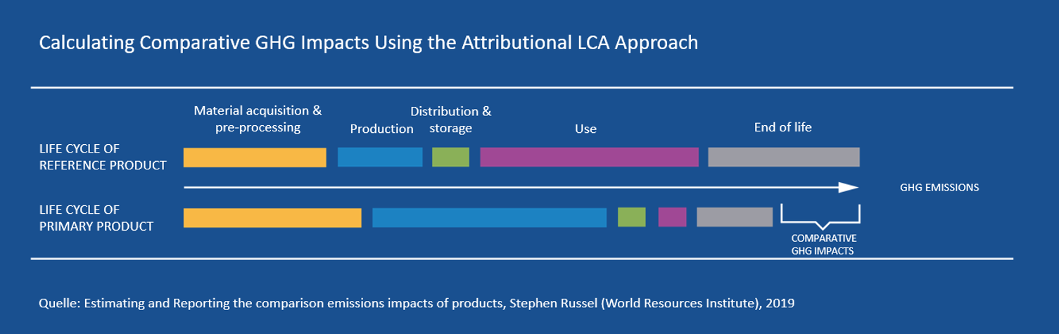
The solution lies in circular product design: products must be developed to comply with the Ecodesign for Sustainable Products regulation (ESPR), with the longest possible life span in use and remaining in circulation post-use. Sustainable products in circular quality – even if they have a higher cradle to gate emission level as shown in the graph – have a positive life cycle impact over linear, short-lived products. To achieve this positive emission gap, products must be designed with the end of their life cycle in mind – using raw materials that are „healthy“ and safe for the environment and fabricating products that incorporate all R-Strategies from Repair to Recycling in circular quality right from the outset. Ecodesign is collaborative effort: it requires close cooperation along the entire supply chain as well as the involvement of consumers and users.
The benefits of circular product design
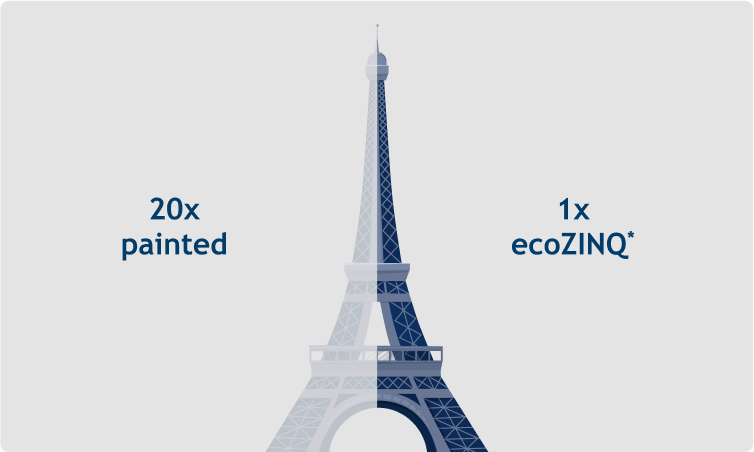
Sustainable, eco-friendly, recyclable, free of microplastic emissions and pollutants: the Eiffel Tower can only dream of such qualities. For lack of alternatives, the 7,300-ton steel structure was painted back then to protect it from corrosion. But: The landmark is in poor condition, even though the tower has been painted 20 times since its construction. Over €80 million has been spent to repair the damaged paintwork—without lasting success!
With ecoZINQ as a Cradle to Cradle Certified® surface, this maintenance effort would have been significantly lower. While traditional paint coatings must be regularly renewed, ecoZINQ provides long-lasting corrosion protection with a reduced ecological footprint over its entire life cycle, as ecoZINQ generates 43% fewer CO2 emissions than conventional hot-dip galvanized surfaces that comply with the DIN EN ISO 1461 standard.
If Gustave Eiffel had been able to use ZINQ surfaces when he built his tower, we would still be seeing the original coating today! Not a single coat of paint would have been necessary to this day! More than 1,000 tons of CO₂, around 75 million euros in maintenance costs, and large quantities of microplastics would have been avoided.
 low carbon, C2C quality ZINQ coating
Circular product design with R-Strategies
ZINQ surfaces are designed for circularity: they last for decades (slow the loop), are material-healthy and are recyclable in circular quality (close the loop).
In our circular business model Planet ZINQ, all circular R-Strategies are interlinked and designed into our coating products – from Reduce to Reuse, Repair and Refurbish to Recycle. We have supplemented these with Re-Design and Re-Place, because both products and entire business models can be further developed in a circular manner and thus be made truly sustainable. But this requires Rethinking & Redesigning products to Replace noncircular materials and that is exactly what Planet ZINQ aims to contribute to.*
*Source: Extended R-Strategies (own representation based on PBL (2021)/Rijkswaterstaat (2024))
Read further


Together for a
sustainable future.
Get in touch.